7 Warning Signs Every Parent Should Know
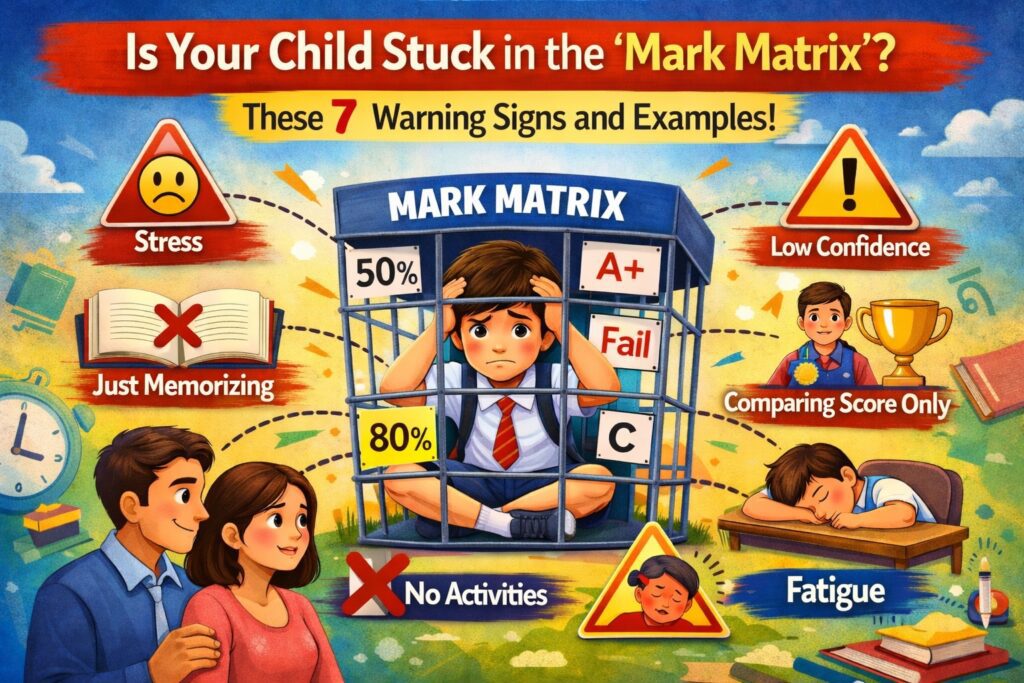
In today’s competitive world, the line between education and marks is slowly disappearing. Many children are stuck in a system where their only goal is to score well in exams.
This unhealthy cycle can be called the “Wrong Study Matrix” or “Marks Matrix.”
When a child is trapped in this matrix, learning becomes stressful, creativity fades, and the joy of learning disappears.
Let’s understand 7 clear signs that show whether your child is stuck in this wrong study pattern.
1. Focus on “How Much” Is Memorised, Not “What” Is Understood
When a child’s only goal is to write answers exactly as written in the textbook, learning becomes pure memorization.
Example:
A child can memorize the process of photosynthesis and score full marks in an exam.
But if the same child cannot explain in simple words how plants make their own food when standing in a garden, then real learning has not happened.
2. Curiosity Is Replaced by Exam Fear
A child trapped in the marks matrix does not enjoy the subject.
They only want to finish the syllabus and score marks.
Example:
While studying history, instead of asking
“Why did Shivaji Maharaj build forts?”
the child asks,
“How many marks will come from this lesson?”
This shows that curiosity is slowly dying.
3. Hobbies Are Seen as a “Waste of Time”
When children start believing that playing, drawing, or music is a waste of study time, they are under mental pressure.
Example:
A child who loves drawing feels guilty while painting and thinks,
“In this time, I could have solved two math worksheets.”
This mindset harms mental health and overall development.
4. Self-Worth Depends on Marks
Children stuck in the matrix start believing that marks define their value.
Example:
If a child scores low in math, instead of saying
“I need to improve,”
they think,
“I am useless” or “I am a failure.”
This deeply damages confidence and self-esteem.
5. Fear of Trying New Things
In the marks matrix, making mistakes is seen as dangerous.
Children avoid experimentation because they are scared of losing marks.
Example:
While doing a project, a child copies content from Google instead of using their own ideas—because they fear teachers may not like originality.
This fear kills creativity.
6. Feeling Guilty Even During Free Time or Holidays
If a child feels restless or guilty while relaxing, it means they are under constant academic pressure.
Example:
During Diwali vacation or on Sundays, the child cannot enjoy reading a storybook or playing because they feel
“I should be studying right now.”
This is not discipline—it is stress.
7. Poor Social Skills
When children are focused only on books, they miss out on learning life skills.
Example:
They feel uncomfortable talking to guests, participating in events, or communicating confidently because their entire life revolves around study schedules.
Important Questions for Parents
Ask yourself honestly:
Are we preparing our children only to earn degrees,
or are we preparing them to succeed in life?
Successful people are not successful just because of marks.
They grow because of skills like:
• Critical Thinking
• Creativity
• Problem Solving
• Communication
What Parents Can Do—Starting Today
✔ Ask your child:
“What new thing did you learn today?”
(not “How many marks did you get?”)
✔ Accept mistakes as part of learning.
Real education begins with failure and reflection.
✔ Give hobbies the same importance as academics.
They build confidence, balance, and personality.